Excavations of Oliver’s Mound
The Masterman Excavations
In the years between 1928 & 1930 Mr & Mrs S.W. Masterman carried out excavations at Oliver’s Mound, (grid ref. SO 813 655), in Shrawley. The site is situated on a spur of Keuper sandstone, 60 feet above the riverbank of the River Severn. It is 1.6 miles up-stream from the Holt Lock. The Mastermans wrote two accounts of their excavations, one in the Worcestershire Archaeological Transactions, and the other in Worcestershire Naturalists’ Club Transactions. Click on the following link for an article written by S.W. Masterman for the Parish Magazine in November 1929 – Oliver’s Mound
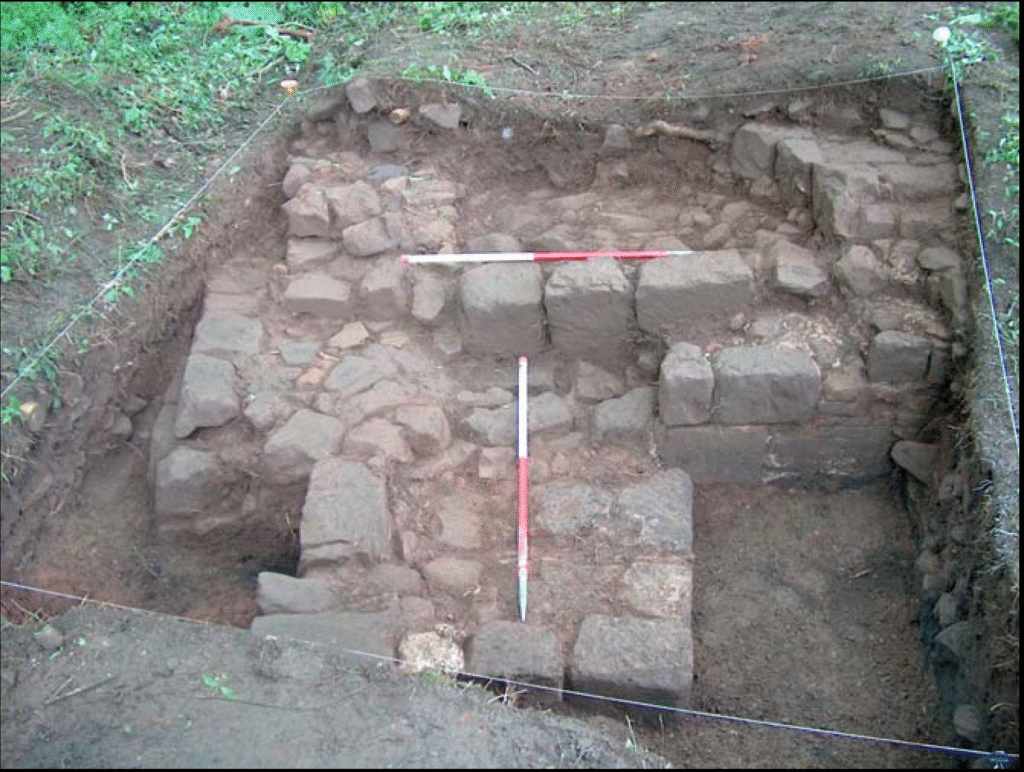
The Mastermans’ excavations show that although no stonework existed above ground, evidence of walls built of the local red sandstone, still existed. The lack of standing stone shows that much of it was carried away when the castle was abandoned, probably after the time of the English Civil War.
The excavations reveal that a tower measuring 27 feet square was probably the main hall, and a building outside the wall. They also uncovered the base of an octagonal tower with a small section of curtain walling. Conjecture is that the castle existed in a rectangular form with octagonal towers at each corner.
Archaeological finds, found by Masterman, at the excavation site included:
- Spindle whorl of baked clay.
- Pottery sherds with green glaze, 14th century.
- Handle of a bone imolement found at tne oase or tne tower.
- Bronze coin, dated 14th century, used as a reckoning counter.
- Part or a sandstone capital, (9 ins. high), and a shaft ornamented with a pollard pattern, 13th Century. see fig. 2.
- Parts of the Norman Tower, occupied until the 14th century.
- Curtain wall of sandstone blocks, 9-10 feet in length, three courses deep, fronting along the river side of the castle.
- Evidence of robbed out walls. Ruins of castle removed and used as a source of wall stone around the village.
- A bed of ashes, on the floor of central tower, probably indicating its means of destruction.
- Bones of ox, deer, pig, and sheep, etc.
- Pieces of slag and a large headed iron nail found against the wall, indicating later iron working, and a piece of bronze casting found at the north end of the mound.
More Recent Excavations
More recently, excavations were carried out by the North Worcestershire Archaeology Group (now the Hwiccian Archaeology Group) between 2009 and 2012. Reports from these excavations can be downloaded from the links below.
Oliver’s Mound Archeological Excavation Report May 2009 by Chris Clarke
Oliver’s Mound Archaeological Excavation Report Dec 2012 by Chris Clarke
Olivers Mound Animal Bone report Oct 2010 by S Hamilton-Dyer and S Warman
Medieval arrowheads from Oliver’s Mound Oct 2010 by Murray Andrews
Olivers Mound Metalwork report Jan 2012 by R.D. Sproat
If you are interested in local archeology then please contact the Hwiccian Archaeology Group via facebook